News flash: SaaS is not dead. Everyone needs to calm down.
Yes, AI just walked into the room and changed the mood. Budgets are tighter. Boards are asking why they are spending millions on software while every headline screams that AI can do it all.
If you are a product, strategy, or technology leader, you are feeling two competing truths at once. You see incredible new AI capabilities. You also see a stack of contracts, renewal dates, and a CFO asking what to cut.
Why It Suddenly Feels Like SaaS Is Over
The story in the market sounds familiar. Multiples are down. Growth is no longer enough. A company can grow 50% year over year and still watch its stock drift sideways because investors are not valuing software like they used to.
Analysts at firms like Bain and IDC are seeing the same pattern. Net revenue retention is flattening, traditional seat based models are getting pressured, and AI is soaking up attention and budget.
On top of that, no one is sure what any product's AI capabilities will look like in three years. That uncertainty gets priced into valuations. It also gets priced into how your CFO looks at every contract on your stack.
The fear is real. But SaaS is not dead. What is dying is mediocre software at premium prices.
The New Question In Every Budget Review: Why Not Build It Ourselves
Inside boardrooms and QBRs, executives are asking the same thing.
Why are we paying a million dollars a year for Slack or Teams or our CRM or scheduling tools like Calendly? Why not just build our own now that engineers can vibe code with tools like Claude?
On the surface that sounds smart. Underneath, it is a trap.
If you are a billion dollar energy company, why would you build and maintain your own calendar or scheduling platform? Do you really want to own an internal tool that breaks 70% of the time, forces your best engineers into low leverage maintenance work, and still falls short of what a focused SaaS team ships every month?
Internal tools are cheap to spin up. They are expensive to live with. Every internal workflow you casually automate becomes a system you now have to secure, support, update, and integrate forever.
That is the part most leaders underestimate.
Vibe Coding Is Not A Strategy
Right now, many teams are handing AI coding tools to engineers and watching a lot of enthusiastic building. Dashboards. Scripts. Micro apps. Automations everywhere.
It feels productive. It is not always strategic.
If your biggest issue is already that engineers are building a flood of features that do not tie back to a clear product strategy, unleashing unfocused vibe coding only makes that worse. You would never hire a thousand employees and tell each of them to go fix whatever seems interesting. Yet that is exactly how many companies are approaching internal AI driven development.
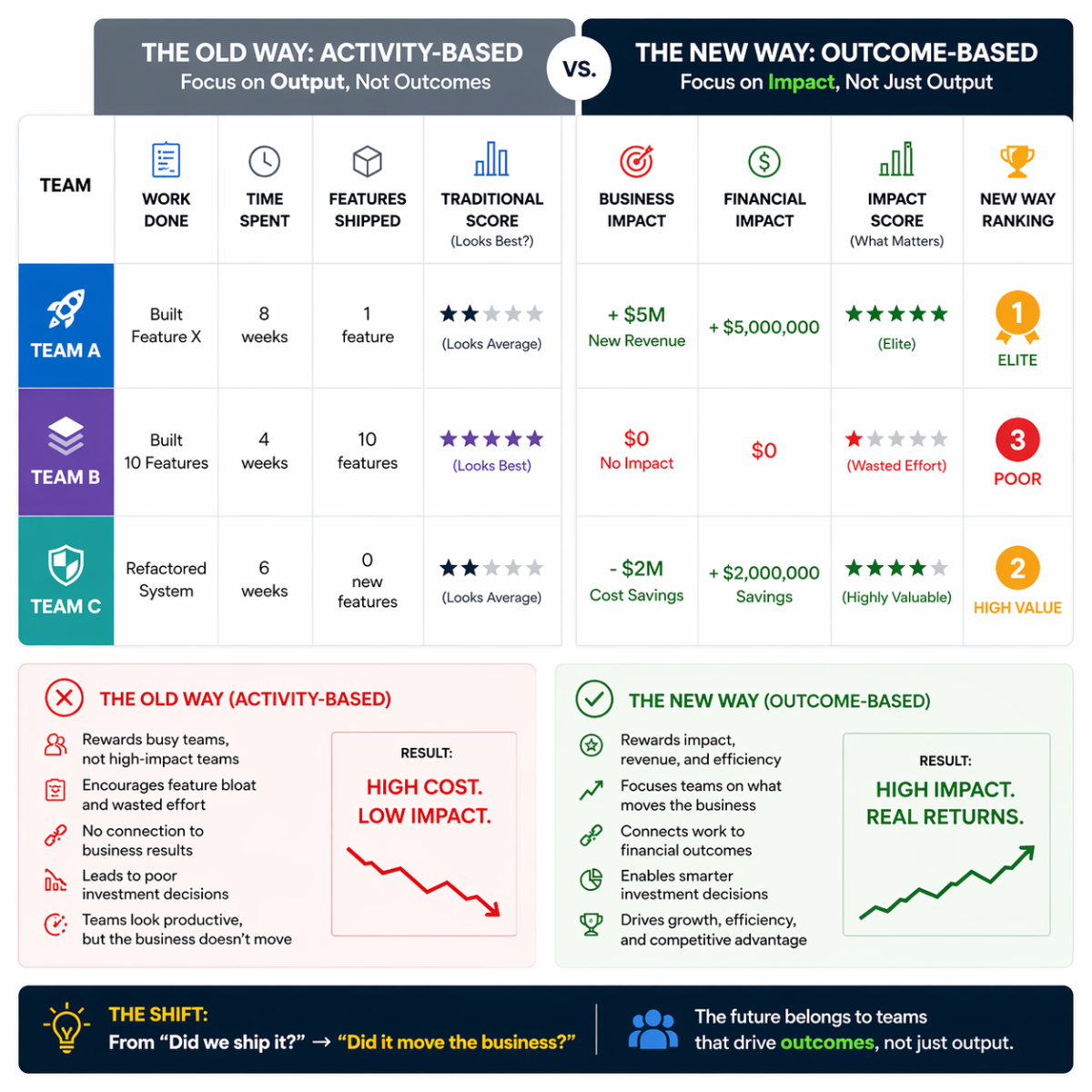
This is where outcome visibility and product leadership matter. If you are not crystal clear on the outcomes you are driving toward, AI just helps you move faster in random directions. I wrote about this shift from activity to impact in more depth in this piece on tracking outcomes and again in the move from velocity to value.
AI generated code does not make ownership, lifecycle decisions, or maintenance costs disappear. It just hides them for a while.
What Good SaaS Still Does For You
There is a reason software exists as a product category rather than everything being internal scripts.
Historically, a lot of SaaS has failed at one big thing: flexibility. Tools were configurable, but not truly personalized to the way your company works.
That is what AI is changing.
As firms like Deloitte and BetterCloud point out, SaaS is evolving into intelligent, adaptive systems. Your data is finally usable in real time. AI can reshape workflows, content, and guidance for your specific context instead of forcing you into a one size fits all model.
The net result is simple. You get the guardrails and reliability of a product plus the relevance of something that feels like it was built for you.
AI Is Transforming SaaS, Not Replacing It
We are not heading toward a world where you rip out all your core systems and talk to one giant AI instead.
We are heading toward a world where AI is woven into every system you already rely on.
Analysts expect this trend to accelerate. Deloitte writes about a shift toward AI agents coordinating work across applications. IDC talks about conversational interfaces sitting on top of modular backends instead of rigid app silos. You can dig into those perspectives here and here.
From a value perspective, investors are already rewarding this shift. Research summarized by Livmo shows that buyers assign a clear premium to SaaS companies with deep, structural AI woven into core workflows, not just cosmetic features.
So no, AI is not the reason software disappears. AI is the reason software has to grow up.
How To Lead Your Stack Through This Reset
Executives are right to ask which tools to cancel. There is real waste in most stacks. But if you stop there, you miss the opportunity.
Here is how I coach leaders to navigate this shift.
1. Start With Outcomes, Not Licenses
Before you cut or build anything, get aligned on the outcomes that matter this year. Revenue per rep. Cycle time from idea to release. First response and resolution time in support. Whatever is core to your strategy.
Then ask a sharper question. Where are the biggest opportunities to improve those outcomes using the tools you already own plus AI extensions on top of them?
This is the mindset shift I talk about in moving beyond execution and in stepping into true product leadership. Your stack is not a cost center to trim in isolation. It is an engine to tune against outcomes.
2. Ruthlessly Cut Stagnant, Legacy Tools
You already know which tools are not pulling their weight. They have not modernized in years. Their AI story is vague. Teams complain, but you keep renewing because switching feels painful.
The reality, highlighted by data from Zylo, is that AI features and usage based pricing are introducing real cost volatility. That is even more reason to exit tools that are not clearly creating value.
If a vendor has not shipped meaningful improvements or a credible AI roadmap in the last few years, do not expect that to change suddenly now.
3. Double Down On Platforms That Evolve With You
On the flip side, some tools are clearly becoming more intelligent and integrated. BetterCloud calls out the shift from point solutions to platforms with stronger automation, security, and governance.
For those systems, your job is to push harder. Work with the vendor. Co design AI features that fit your workflows. Measure impact, not logins. Expect more personalization, not just more buttons.
4. Put Guardrails Around Internal Builds And AI Automation
You absolutely should build internal tools where they unlock real advantage. But they need the same discipline as any external product.
This is where thinking in terms of product life cycles matters. If you greenlight an internal app, you are implicitly signing up for a full journey from concept through sunsetting. I break this down more in this guide on navigating the product life cycle.
5. Connect Stack Decisions To A Clear Narrative
People need to understand why certain tools stay, others go, and where AI fits. That is not just a procurement exercise. It is a storytelling exercise.
When leaders explain how stack changes tie to outcomes, teams can align their decisions and behavior. Without that story, every cancellation or new rollout feels arbitrary. If you want a deeper dive on this, I shared more in this piece on storytelling for product leaders.
SaaS Is Not Dead. Lazy SaaS Is.
The market correction is real. Basic SaaS without a strong AI and outcome story will keep seeing pressure on multiples and renewals.
But this is not the end of software. It is a cleanup cycle and a reset.
The leaders who win this chapter will do a few simple things consistently.
That is the philosophy we follow at Iteright and in the work we do helping teams connect product decisions to real business results. If you want to see how this thinking plays out across initiatives, you can explore more of our perspective here.
SaaS is not dead. Weak, unfocused, and unaccountable software is. The next era belongs to leaders who use AI to extend what already works, cut what does not, and stay relentlessly anchored on outcomes.