Your roadmap is full. Your team is busy. But are you confident it's the right work — and can you prove what it's producing? Iteright is the easiest way to show that the current work is actually tied to the outcomes that matter.
The strategy execution gap
Strategy lives in decks.
The plan is documented, reviewed, and approved. Then execution begins — and the connection between strategy and daily work quietly breaks.
Work lives everywhere else.
Jira, ADO, ServiceNow, spreadsheets, meetings, and AI tools each hold a piece of the picture. No single view connects them to the plan.
Leadership is flying blind.
The roadmap is full. The team is busy. But leaders still struggle to see how priorities connect to execution and outcomes.
See what work is aligned to the plan, what is reactive, and where capacity is being pulled off course.
Pressure-test opportunities against strategy, customer evidence, expected impact, feasibility, risk, and confidence.
Connect initiatives to the outcomes they are expected to drive — growth, retention, monetization, efficiency, customer value — and report progress with confidence.
Iteright answers all three continuously —
not just at roadmap reviews, QBRs, or board prep.

Bring what you have. Leave with a clearer picture and a concrete plan.
No credit card · No prep · No commitment
Bring anything. We do the work. You'll leave with more clarity either way.
Bring what you already have
Bring your roadmap, tickets, strategy notes, Jira or ADO export, Linear board, spreadsheet, or even a rough list of priorities. No cleanup, integrations, or long onboarding required — we do the work to turn what you already have into a clear picture of where effort is going, what is aligned, where things have drifted, and exactly what to do next.
What you walk away with
Strategy-to-Execution Map
A clear view of how your business goals, key initiatives, roadmap, and active work connect from strategy down to execution. This shows what your team is trying to accomplish and how current work supports the plan.
Work Focus & Drift View
A practical readout of where team effort appears to be going today, what looks aligned to the plan, and what may be reactive, unclear, disconnected, or pulling the team into "other stuff."
Opportunity Validation & Decision View
A prioritized view of which ideas or initiatives look highest-impact, under-validated, unclear, or ready to move forward — including what to build, pause, clarify, validate, or measure before committing more resources.
Outcome & Next Moves Summary
A leadership-ready summary of the metrics and business outcomes each major initiative should connect to, where measurement is strong or missing, and the 3–5 recommended next moves your team can act on immediately.
Used by VP Products, GMs, strategy leaders, and founders at companies from growth-stage startups to billion-dollar organizations.
The Platform Workflow
Six steps that turn business goals into shipped product — and prove it worked.
Before anyone touches the backlog, establish a shared view of what the business is actually trying to achieve — strategies, impact metrics, targets, and the outcomes that define success.
Creates
Ideas come from everywhere. Pressure-test each opportunity against strategy, customer evidence, effort, risk, and confidence — before the team commits a single sprint.
Creates
Turn the strongest opportunities into a focused roadmap — not just a list of features, but a business plan for how product and engineering effort drives real growth and outcomes.
Creates
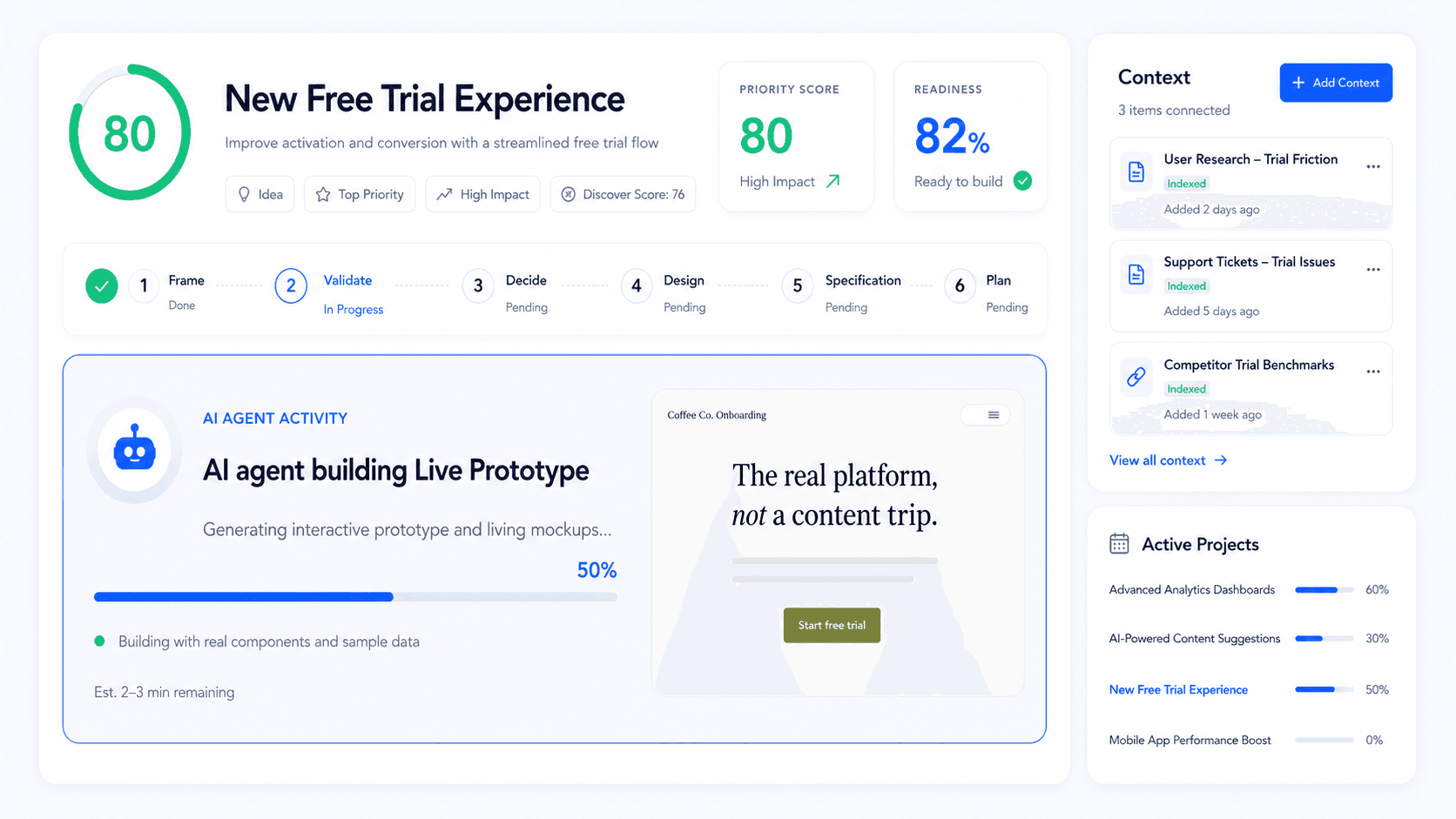
AI agents generate every artifact needed to move from validated opportunity to engineering-ready execution — grounded in strategy, customer context, and current business goals.
Creates
Connect active work back to the roadmap. See where effort is actually going, what's unplanned, where capacity is being consumed, and where the team is starting to drift.
Creates
Connect every initiative to the outcomes it was expected to drive. Turn reporting from 'here's what we shipped' into 'here's the business impact — and what we should do next.'
Creates
The full loop
01 — Speed
The slowest part of building product isn't the building. It's all the translation work in between: turning a conversation into a brief, a brief into requirements, requirements into a ticket. That translation layer is where momentum dies.
“What used to take us three weeks to get to alignment now happens before the next standup.”

Product screenshot coming soon
02 — Focus
Every team starts the quarter with a plan. Then reality hits. A customer escalation lands. An executive has a new idea. A competitor makes a move. Weeks later, the plan exists on a slide deck and the work has quietly drifted. Most leaders only find out after the sprint.
“We finally have a way to see the whole picture before it's too late to change it.”
03 — Clarity
Speed only matters if you're moving in the right direction. Before a team commits resources to an opportunity, they should be able to answer: Why this? Why now? What do we expect it to do? Most teams can't answer those questions clearly — so they default to the loudest voice in the room.
“We stopped building things we couldn't explain. That's a bigger deal than it sounds.”
Product screenshot coming soon
04 — Outcomes
Activity is easy to measure. Outcomes are not. Most teams can tell you how many tickets closed. Fewer can tell you whether the work moved the number it was supposed to move — or why it didn't. That gap isn't a data problem. It's a planning and connection problem.
“We went from hoping things worked to actually knowing. That changes how you lead.”
Iteright learns your organization: strategy, customers, market, roadmap, tickets, resources, metrics, past decisions, and current execution. Every AI recommendation, prioritization call, and artifact is built from that context — not a blank prompt.
The 8 intelligence sections
Everything agents need to work like your smartest team member. All in one place. Always current.
Detailed profiles of who you're building for — behavioral patterns, core frustrations, what they care about most.
The real job behind every feature request. Agents understand what users are actually trying to accomplish.
The 3–5 commitments that define how you win. Every opportunity gets scored against these automatically.
System design, tech stack, key integrations — what exists and how it all fits. Dev handoffs reference this so engineering never starts blind.
Visual language, tone, personality, and aesthetic rules. Agents write in your voice and design for your brand.
Who you're up against, where you differentiate, and where the market has left users underserved.
The end-to-end experience across every touchpoint — where users win and where they struggle.
The numbers that define winning for your product. Every launch is benchmarked against these from day one.
Bring your roadmap, tickets, or strategy notes. Walk away with a clear view of where effort is going, what is aligned, and what to do next.
Bring anything. We do the work.
Live demo
“AI Weekly Content Plan” — a real idea, run by real agents, in real time.
Owner: Tyler
Agents consistently struggle with weekly content decisions. An AI-generated weekly plan removes friction and drives consistent posting.
Pipeline progress
Artifacts generated
Introducing your personalized team of agents
You just hired 15 agents who are geniuses on your strategy, your customers, your market, and everything that matters to your business.
Not generic chatbots — never losing context between handoffs. You own every decision. They own the work.
Recent Agent Activity
Last 60 minutes
Turns messy product thoughts into a clear, actionable working idea.
Formalizes ideas into validated product opportunities with evidence.
Pressure-tests every opportunity against your full product context.
Reads your Brain to generate strategic pillars, impact metrics, and gaps.
Translates validated opportunities into designed, principled product experiences.
Writes the prompt that builds your branded, production-ready prototype.
Turns subjective user feedback into clear prototype iteration instructions.
Prepares the team for the final decision with full context in hand.
Creates the build-ready package engineering needs — zero interpretation gaps.
Checks whether the live build matches exactly what was approved.
Closes the loop — connecting what shipped to what it actually achieved.
Finds the needle in the haystack — surfacing exact evidence from your transcript library.
Plans what can realistically get done with the people and hours available — and shows where to fix it.
Turns messy imports — ServiceNow exports, Jira dumps, strategy docs — into clean, structured product intelligence.
Why teams stay
Once a product leader sees their roadmap, resources, execution, and outcomes connected in one place, the old way feels impossible to go back to.
Not because Iteright adds another process.
Because it gives the product team a clearer way to decide, focus, execute, and explain the impact of the work.
Strategy notes, customer calls, roadmap ideas, and leadership priorities become validated opportunities, PRDs, prototype prompts, and executive updates without weeks of back-and-forth. The context is already there. The AI does the heavy lifting.
Customer requests, bugs, sales asks, and executive ideas pull teams off plan constantly. Iteright shows what's actually in motion, how it maps to strategy, where effort is drifting, and where capacity is constrained — without micromanaging anyone.
Every opportunity evaluated across strategic alignment, customer evidence, expected impact, feasibility, risk, and confidence. If leadership challenges the roadmap, you can defend it — with data, not just instinct.
Move from 'we shipped this quarter' to 'we invested here because of this strategy, we expected to move these outcomes, and here's what we're learning.' The update writes itself.
Pricing
Every entry point creates real value before you spend a dollar. Most companies start with the free snapshot and never look back.
The clearest view you've ever had of your team's focus.
For VPs, product leaders, and founders starting personally.
For the team doing the work. Shared workflows, full visibility.
Multiple teams, integrations, resource intelligence, full reporting.
How companies grow with Iteright
Start here — walk away with clarity on where your resources are going and what to do next.
A VP or founder starts using Iteright personally. Better decisions, faster artifacts, cleaner reporting.
The whole product team comes in — shared workflows, full visibility across the plan.
Hands-on setup of strategy, ingestion, resources, and executive reporting.
Multi-team, integrations, full outcome intelligence across the organization.
Every plan starts with a free snapshot. No credit card required. You leave with a clearer plan either way.
From product and engineering to finance, strategy, transformation, and investors — Iteright gives leaders one connected view of what matters, what teams are working on, where resources are going, and what outcomes the work is producing.
Turn strategy, roadmap ideas, and active work into a clear operating system.
VPs of Product use Iteright to validate what is worth building, focus teams on the highest-impact priorities, reduce drift from stakeholder requests, and create leadership-ready updates that show what product is driving for the business.
The team is shipping. The roadmap is full. Everyone is working hard. But growth, retention, monetization, or efficiency is not improving fast enough — and the product leader has to answer the harder question:
“Are we building the work that will actually move the business?”
Iteright helps you pressure-test the roadmap against strategy, customer evidence, expected impact, effort, risk, and confidence — then shows where product and engineering effort is focused and what outcomes the work should drive.
Free · No credit card · Bring what you already have
Iteright helps make sure it's going to the right work.
Bring your roadmap, tickets, strategy notes, Jira export, ADO export, Linear board, spreadsheet, or even a rough list of ideas. Iteright turns what you already have into a clear Strategy Execution Snapshot — showing where the team is focused, what maps to your priorities, where work may be drifting, and which 3–5 moves would create the most impact next.
Get Your Free Product Strategy SnapshotBring anything. We do the work. You'll leave with more clarity either way.
Common questions