Why Product Teams Must Be Measured by Impact, Not Output
I’ve been thinking a lot about how we measure software teams.
Because something fundamental just broke.
For less than $50, I can build almost any app I can think of. AI has collapsed the cost of development. And yet, companies aren’t growing faster. In many cases, selling has actually gotten harder.
That gap should make every product and strategy leader pause.
The Old World Was Built Around a Bottleneck That No Longer Exists
For the last 20 years, we optimized everything around one constraint: building software was hard.
Development was expensive. Cycles were long. Engineering bandwidth was limited. You had 100 ideas and maybe capacity to build a handful each year.
So we built an entire system around output:
- Agile
- Story points
- Velocity charts
- Sprint efficiency
- Roadmaps
Shipping something was the win. It showed progress. It showed activity. It showed value.
That’s where feature factories came from. The teams that shipped the most features were seen as the best teams.
And to be clear, that made sense.
In that world.
The New Reality: Building Is No Longer the Constraint
That world is gone.
AI has changed the economics of software completely. Development is now fast, cheap, and accessible. Founders can build products in days. Non-technical leaders can prototype ideas before engineering is even involved.
If large companies are still taking months to build basic functionality, that’s not a technical limitation anymore. That’s an operating model problem.
Everyone is building now. CEOs, CFOs, HR leaders. Ideas are no longer scarce. Execution speed is no longer rare.
Which means something important:
Activity is no longer a proxy for value.
Shipping a feature doesn’t mean anything by itself.
Hitting a deadline doesn’t mean the business moved forward.
And yet, most organizations are still measuring success exactly that way.
This disconnect is showing up everywhere. According to Atlassian’s State of Product 2026 report, teams feel increasingly responsible for outcomes, but lack the systems and time to actually connect their work to meaningful results.
So they default back to what’s easy to track: output.
The Real Problem: We Can’t See What Actually Drives Results
Here’s the uncomfortable truth.
Most companies have no idea which product or engineering work is actually driving ROI.
No clear system links effort to business outcomes.
No consistent way to connect features to revenue, cost savings, retention, or growth.
So what happens?
We keep measuring what we can see:
- Tickets completed
- Lines of code
- Velocity
- Release volume
But none of that tells you if the work mattered.
Let’s make this real.
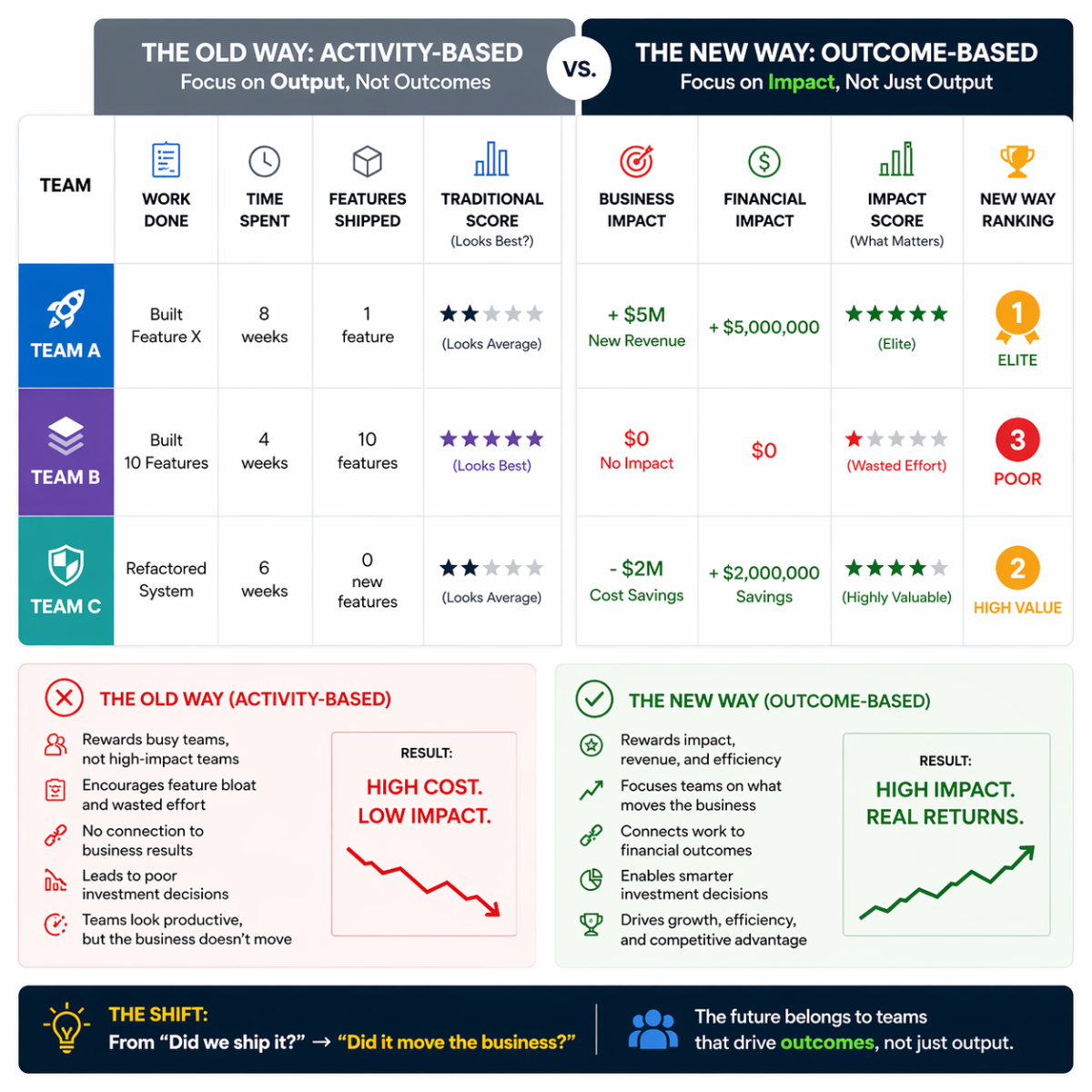
One team ships 10 features in 4 weeks. None of them move a key metric.
Another team ships 1 feature in 4 weeks. It drives $5M in revenue.
Which team performed better?
The answer is obvious.
But our measurement systems rarely reflect that reality.
This is exactly the gap we’ve been digging into at Iteright and in conversations with hundreds of product and strategy leaders. And it’s also why so many teams feel busy but not impactful.
We’ve spent decades optimizing how to build.
We’ve barely started optimizing what actually drives results.
This Is Where Product Strategy Has to Evolve
If building is no longer the constraint, then the game fundamentally changes.
The advantage no longer goes to the team that ships the most.
It goes to the team that learns the fastest and invests in the right things.
This shift is already happening. You can see it in broader product trends, where leaders are moving toward outcome-based accountability and tying product decisions directly to business performance, as highlighted in Product School’s 2026 product trends.
But most organizations haven’t caught up yet.
They’re still operating with old metrics in a new world.
And that creates noise, misalignment, and wasted investment.
So What Needs to Change?
If you’re leading product, engineering, or strategy right now, this is the shift:
Stop managing output. Start managing return on investment.
That sounds simple. It’s not.
Because it requires rethinking how you evaluate work, teams, and decisions.
Here’s what I’ve seen actually work:
- Treat initiatives like investments
Every project should have a clear expected ROI before it starts, and a measured actual ROI after it ships. No different than how you’d evaluate any capital allocation decision. - Compare teams based on impact, not activity
Stop looking at velocity as the primary signal. Start asking: which teams are driving measurable business outcomes? - Connect work directly to KPIs and financials
If a feature ships, you should be able to trace its impact to revenue, retention, cost reduction, or efficiency. If you can’t, it’s just activity. - Allocate resources like a portfolio
Double down on high-performing initiatives. Cut low-impact work quickly. Reallocate talent based on where value is being created. - Build visibility across execution and outcomes
This is the hardest part. Most tools don’t do this well today. But without it, you’re operating blind. This is something we’ve explored further in this breakdown on outcome tracking.
This also changes how individuals are evaluated.
The conversation is no longer “how much did you ship?”
It becomes “what outcomes did you create?”
And over time, compensation, org structure, and influence will follow that shift.
You’re already starting to see signals of this in the market. High-impact builders and product leaders are becoming disproportionately valuable.
Because in a world where everyone can build, judgment becomes the differentiator.
The Bigger Shift Most Leaders Are Missing
This isn’t just a measurement problem.
It’s a mindset shift.
For years, product management has been tightly tied to execution: roadmaps, delivery, stakeholder alignment.
Now it’s moving much closer to business ownership.
Every decision needs to connect to growth, efficiency, or strategic advantage.
That shift is showing up clearly in how the role is evolving. Product leaders are being asked to think more like investors, not just operators, a theme explored in this analysis on product management trends.
And that’s uncomfortable for a lot of teams.
Because it removes the safety of output-based success.
You can’t hide behind shipping anymore.
You have to prove impact.
Final Thought
The cost of building software is collapsing.
The cost of building the wrong things is not.
That’s the tension every leadership team is now dealing with, whether they’ve articulated it or not.
So the question is simple:
Do you actually know which work is driving value in your organization?
Or are you still measuring motion and calling it progress?
Because the companies that figure this out first are not just going to move faster.
They’re going to allocate better, focus sharper, and outperform in a way that looks obvious in hindsight.
And everyone else is going to wonder why shipping more didn’t get them there.