
Let me start with something I wish someone had told me earlier in my product career.
Right above your head, there is a scorecard that runs your company.
Five or six numbers. Reviewed quarter after quarter, year after year. Those numbers define success or failure for your C-suite.
Revenue. Cost savings. EBITDA. Expansion targets. Maybe a specific growth rate the board expects next year.
That scorecard is everything to them. It is how they talk to the board. It is how they decide bonuses. It is what they wake up worrying about.
And yet, across hundreds of conversations with product and strategy leaders, I see the same pattern.
Most product teams have never even seen that scorecard.
They do not know what metrics are on it. They do not know the actual targets. They do not know which strategies leadership believes will move those numbers.
Meanwhile, those same product and engineering teams are burning ten million dollars or more every year.
Massive investment. Almost no explicit connection to the only numbers that truly matter at the top.
That is the gap.
The Scorecard That Runs Your Company
Inside the executive team, that scorecard is not just a static report. It is a living argument.
They debate it. They design multi quarter plans around it. They make promises to the board based on it.
If the plan is to grow revenue twenty percent in 2026 and you are tracking to ten percent this December, they are already asking hard questions.
What did we expect to happen? Which bets worked? Which ones fizzled? Where are we over invested? Where are we exposed?
Those conversations are happening. You just are not in the room.
So product teams end up doing the worst possible thing: working very hard on things that might matter, without knowing if they actually do.
Why Misalignment Shows Up On Your Roadmap
Here is a simple example.
Imagine the company level goal is to grow revenue.
Fine. Almost every roadmap slide claims to support that.
But inside the scorecard, that goal shows up in very specific ways.
Maybe the actual bet is to expand into two new countries.
Or maybe the real focus is to grow share within existing enterprise clients.
Same high level revenue goal. Completely different product strategy.
International expansion pushes you toward localization, tax and compliance, payments, and partner integrations.
Enterprise expansion pushes you toward account based workflows, security features, admin controls, and deeper analytics.
If you do not know which path leadership has already committed to, your roadmap is a guess.
Scorecards Are Everywhere Else In The Business
Other functions in your company already live and breathe through their scorecards.
Strategy and operations teams use balanced scorecard tools like Spider Impact from Spider Strategies to track financial, customer, process, and learning metrics in one place.
Marketing teams roll up their KPIs into focused executive reports with platforms such as DashThis executive scorecards, so leaders can see campaign performance at a glance.
HR teams are starting to lean on balanced HR scorecards to connect people investments to business outcomes, like the approaches described by TMI and Wowledge.
If you want a deep dive on how to design scorecards, there are plenty of frameworks and tools out there.
What I rarely see, though, is product in that same conversation.
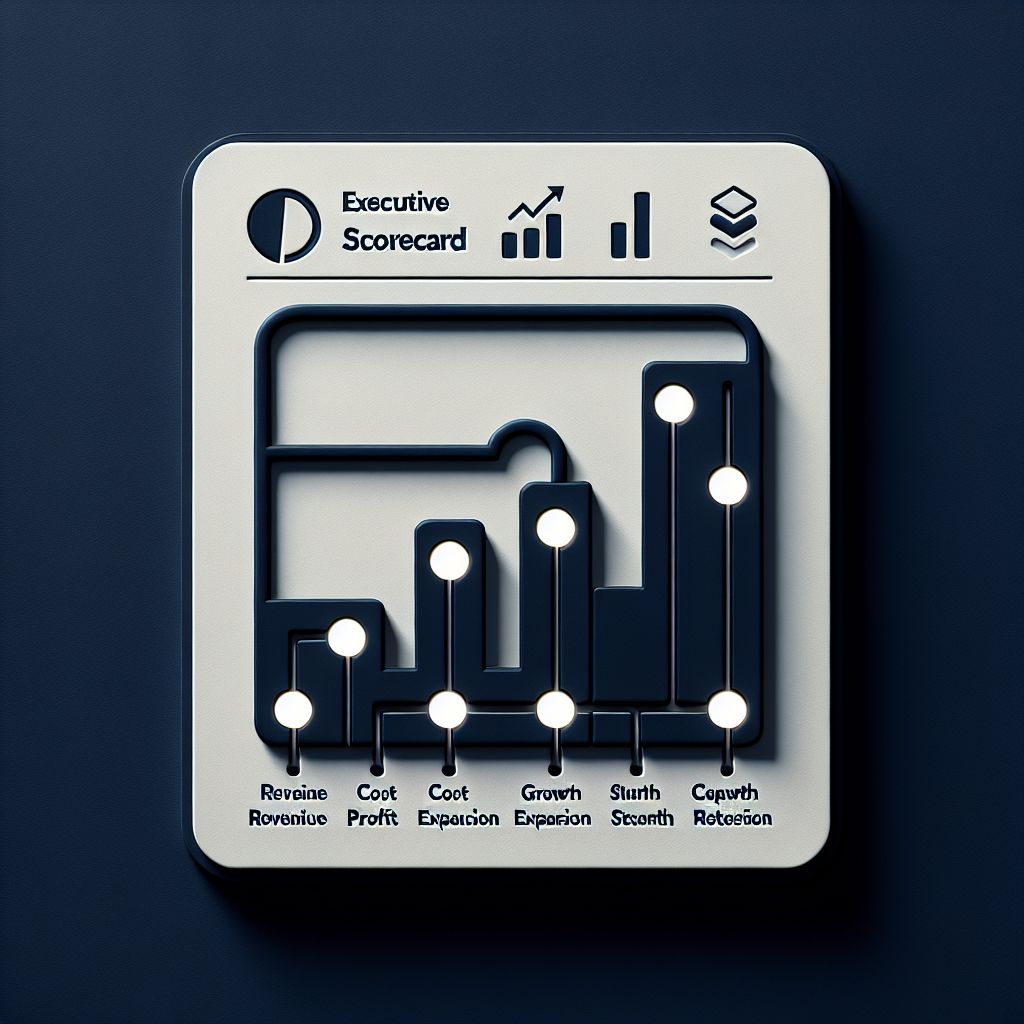
The executive scorecard exists. It might even be connected to sophisticated software. But the people building the product do not see it or use it.
That is the miss.
What The Best Product Leaders Do Differently
The best product and strategy leaders I work with treat the executive scorecard as their source of truth.
They start by getting crystal clear on the top five or six metrics the business is actually judged on.
Then they go one level deeper.
Not just revenue, but revenue from where, by when, and through which customer or product levers.
Not just cost savings, but which cost buckets, how much, and on what timeline.
From there, they translate that language into product terms.
This is where tools and frameworks can help. For example, product teams are using product scorecards like the ones described by Product School to connect product health, engagement, and business outcomes.
Teams on platforms like Productboard are tying roadmap initiatives directly to company OKRs and strategic themes instead of just feature lists.
Strategy platforms such as Rhythm Systems help leaders cascade KPIs and scorecards throughout the organization so everyone sees the same priorities.
None of these tools fix the root issue by themselves.
The mindset shift is what matters.
You stop thinking about how to ship more and start thinking about which executive metrics you are accountable for moving and how you will measure that from the product side.
If this sounds familiar, it is probably because you have already felt the friction of teams measuring output instead of outcomes. I wrote more about that shift in this breakdown on tracking real outcomes and in this piece on moving from velocity to value.
Six Moves To Make The Executive Scorecard Real For Your Team
Heading into 2026, your job as a product leader is simple to state and hard to do.
Make the executive scorecard transparent. Then connect it directly to your product work.
- Find the scorecard. Sit down with your CEO, CFO, or head of strategy and ask to see the actual executive scorecard they report to the board. Get the list of top metrics, their definitions, and the targets for this year and next.
- Decode the strategies behind the numbers. For each metric, ask what the original plan was. If the target was twenty percent revenue growth and you hit ten, what were the specific strategies that were supposed to close that gap? Which ones are they still betting on?
- Map product levers to each metric. For every scorecard metric, list the concrete ways product can influence it. International expansion, enterprise penetration, self serve growth, retention improvements, cost reductions in specific systems. You should be able to point from any roadmap item to at least one scorecard metric.
- Instrument leading indicators. Executives are stuck with lagging metrics like revenue and EBITDA. You can help by instrumenting leading indicators inside the product and your internal tools. Even simple internal analytics that track adoption of a new workflow or hours saved in a core system can be transformative.
- Ruthlessly focus your portfolio. If the company has promised the board a twenty five percent cost reduction through AI, stop spreading teams across fifteen siloed AI experiments. Identify the single most expensive system or process, and align as many teams as needed around a clear program to reduce that cost in a measurable way.
- Codify a common language. Build the habit of asking, for every initiative, how does this increase revenue, reduce cost, or protect the business in a way we can measure? Then go one level lower. How exactly will it increase revenue? How exactly will it reduce cost? Capture that intent in your product briefs, roadmap reviews, and lifecycle decisions. If you want a deeper view on connecting those decisions from concept to sunsetting, I unpack that in this product lifecycle guide.
This Is The Real Job Of A Product Leader
Your job is not just to ship features. Your job is to connect business and technology in a way that shows up on the scorecard your executives live by.
That means you cannot be satisfied with vague alignment. You need a clear, defensible story for how your roadmap influences revenue, cost, and profitability, with metrics that tie both up and down the stack.
The good news is that once you anchor your work to the scorecard, everything gets easier.
Prioritization debates move from opinions to trade offs against named metrics.
Cross functional partners see how their work ties into product initiatives.
Executives stop asking for more features and start asking better questions about leverage and outcomes.
And you become the leader in the room who can explain, in plain language, how technology investments translate into the numbers that drive the business.
At Iteright, that is the heart of how we think about product leadership. Use data, storytelling, and clear frameworks to link what you build to the outcomes the business cares about. You can explore more of that perspective at iteright.com, in this piece on storytelling for product leaders, and across our solutions.
A Challenge For Your Next Planning Cycle
Here is the challenge I would leave you with.
By your next quarterly or annual planning cycle, make sure every roadmap review you run starts with the executive scorecard.
Put the five or six top metrics on the first slide. Show where you stand. Then show how your current and proposed initiatives map to each one, with clear hypotheses and leading indicators.
If your team can do that, consistently, you will not just have a better roadmap.
You will have a seat at the table where the real decisions are made.
Make the scorecard transparent. Connect it to your work. That is your job as a product leader heading into 2026 and beyond.
Make it happen. I cannot wait to see what you achieve.