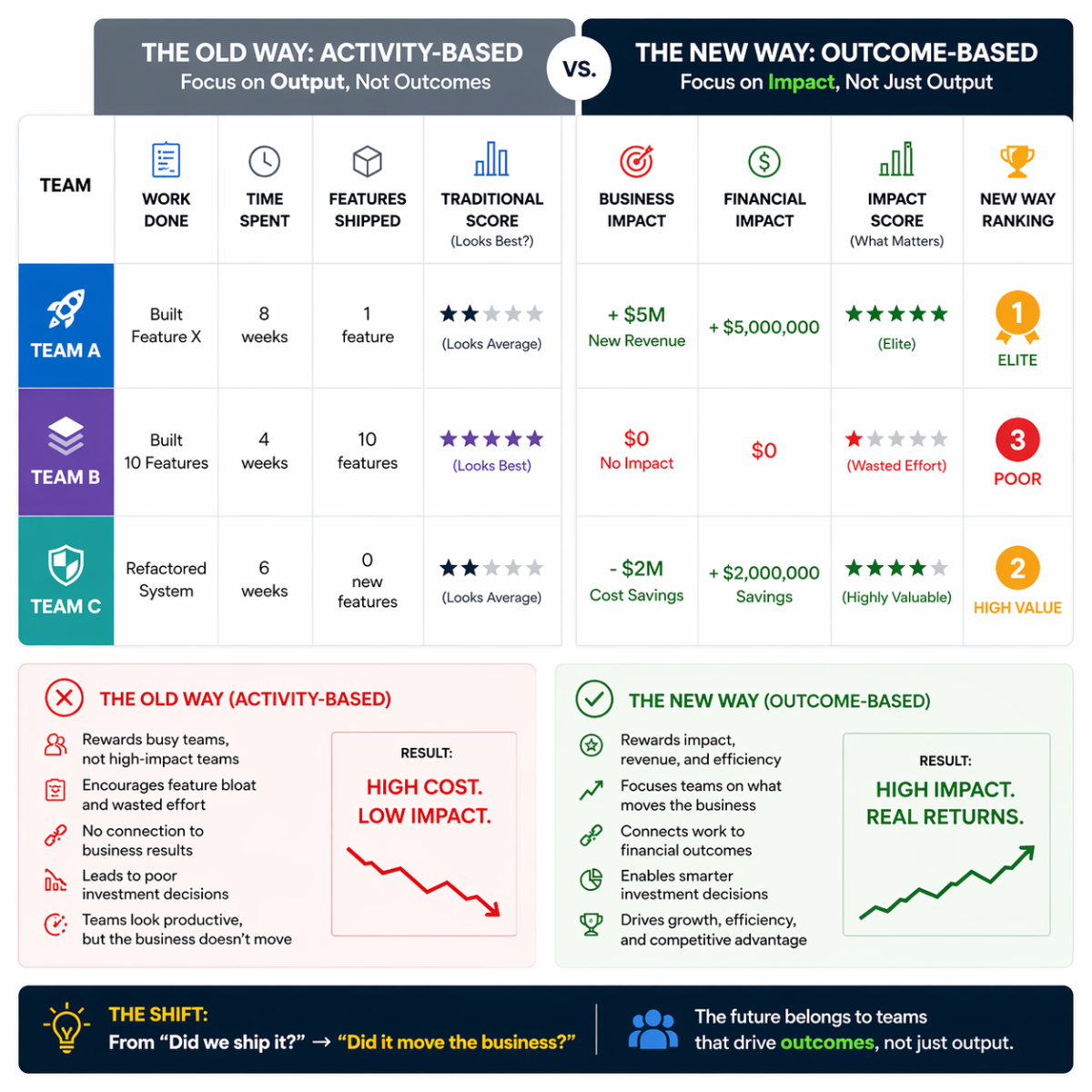
Misalignment Is Not Failure: How Shared Language And AI Create Healthier Product Cultures
There is a very specific kind of tension that lives in product management. If you have ever sat in the middle of business and engineering, you know exactly what I mean.
On one side, the business is pushing for revenue, margin, growth. On the other side, technology is shipping features, fighting fires, paying down tech debt. Product sits in the middle, trying to translate. Everyone is working hard. Everyone believes they are doing the right thing. And still, no one feels truly respected.
I almost never see that tension disappear. The only real exception is inside companies that are actually growing in a healthy, compounding way. Those teams seem to “get it.” They are not perfect, but they are not at war. I have spent years asking myself why.
The quiet tension sitting between business and technology
Inside most mid market and enterprise companies, the pattern is familiar:
You have probably heard versions of this:
Blame creeps in. Roadmaps turn into negotiation tools. Reviews feel like courtrooms. Misalignment becomes something people are afraid to expose, so they bury it under more slides, more dashboards, more spin.
And the ironic part is this: almost nobody in that environment is acting in bad faith. These are good people trying to do good work in a complex system.
Misalignment is not failure, it is a signal
Here is the core shift I want product and strategy leaders to make.
Misalignment does not mean you failed. Misalignment is a signal to get better.
When I walk into an organization and see work that is only 20 or 30 percent clearly aligned to stated strategic goals, I do not assume incompetence. I assume there is:
This is normal. Product work is messy. Customer needs change. Tech debt has to be paid down. Sales brings in that must win deal. Support escalates a performance issue. If we treat every deviation from the original plan as failure, people will simply stop telling the truth.
The best product cultures I see do something different. They accept that reality is complex and drifting. Then they make it understandable. They build a “cone of trust” where people can say:
No shame. No blame. Just shared reality.
What a shared language model actually looks like
Practically, this comes down to one thing: a common language that business and product both trust.
When I say “common language model,” I am not talking about another framework to impose on teams. I am talking about a simple, human way to answer a few questions consistently:
A good head of product should be able to walk into an executive meeting and calmly say:
“Here is what we are executing, here is why, here is how it aligns to our strategic goals, and here are the impact metrics we are watching. Here is the work that is off plan, why we made that tradeoff, and what we learned.”
They should not have to be defensive. They should not be on trial. They are explaining, not justifying.
For this to work, the execution layer needs a real voice. Engineers, designers, customer success, sales teams, people who live in the day to day with customers, all need a safe way to add context:
When that context can travel upward without being filtered by politics, everything gets healthier. This is also where a lot of product teams struggle with outcomes. If you are wrestling with that, I break it down more in this deep dive on outcome tracking and in the shift from velocity to value.

AI as sense maker, not decider
This is exactly where AI can help, and where it often gets misunderstood.
I do not want AI deciding priorities for your business. I do not want a model telling your teams what to do next. That is not leadership.
What I do want is AI acting as a powerful sense maker. Something that can synthesize what humans cannot reasonably hold in their heads:
As Airtable highlights in their 2026 product management trends, AI powered workflows are quickly becoming the default operating model for modern product organizations. Not because they replace product leaders, but because they make it possible to see patterns across planning, building, launching, and learning work.
And if you look at Atlassian's State of Product in 2026, you see the other side. Teams are under pressure, trying to do more strategic work with less time, while AI is mostly used for small productivity boosts. The opportunity is to point AI at the right problem: sense making, not micro tasks.
Imagine being able to say:
That is the power of AI connecting dots across the organization. It gives every layer a way to explain the reasoning behind work, without adding more meetings or more slide decks. Context can finally travel upward without politics.
From policing alignment to enabling it
There is a trap a lot of executives fall into once they start talking about alignment and strategy. They turn it into a compliance program.
You start seeing weekly status reviews that feel like audits. Teams are asked to tag every task to a corporate goal just to prove they are “aligned.” Leaders get reports that highlight misalignment and then use them as ammunition in performance conversations.
That is policing, not leadership. It does not create better decisions. It just teaches people to hide the reality of their work.
Instead, I want leaders to think about enabling alignment:
Misalignment will still show up. The difference is it will show up early, with context attached. And that gives you options. If you want a deeper look at how to connect metrics to business outcomes without creating fear, I like how LogRocket breaks this down for product led companies.
Practical shifts leaders can start this quarter
If you are a VP of Product, CPO, or strategy leader trying to move from motion to impact, here are a few concrete shifts I would make right now.
This is about being good people
Underneath all the models, tools, and AI, this is really about being good people to work with.
Respect. Clarity. A shared language. The ability to say “here is what I am doing and why” without fear. These are the same things that make friendships work, marriages work, any long term relationship work.
You can feel it when it is missing in your organization. The snark in side channels. The careful phrasing in status updates. The sense that every review is a test you can fail instead of a conversation you can learn from.
We can do better than that. Product and business can be on the same side of the table, looking at the same reality, even when that reality is messy. AI can help us see more of the picture. Shared language can help us talk about it. But the decision to treat misalignment as a signal, not a crime, is a leadership choice.
If you are curious how we think about building that kind of culture into the operating system of a company, you can learn more about our perspective at Iteright and in our work on navigating the product life cycle. But regardless of what tools you use, the question is the same:
Are you using misalignment to blame people, or to understand your system well enough to make better decisions next quarter